/filters:quality(70)/prod01/prodbucket01/media/durham-university/support-services-/support-hub/School-of-Education-reception-89893.jpg)
Statement on Information Sharing and Emergency Contact in Student Support
The University is committed to supporting students and their academic progress and personal development. Information given by students to staff involved in their support will be treated with respect, sensitivity, care and discretion. This statement outlines University Policy on the management of personal data within the University and situations when we might need to share information with third parties - individuals or organisations.
The University Data Protection Policy
Our commitment to protect the rights and privacy of students in accordance with appropriate UK and European legislation is demonstrated by our Data Protection Policy (available upon request by emailing info.access@durham.ac.uk).
Information about how we process student data is available in the Privacy Notice - Students: durham.ac.uk/about-us/governance/information-governance/privacy-notices/students
Information sharing within the University
The Privacy Notice - Students confirms that personal data held for the purposes of student support is shared between sections of the University only for the purposes of support, as necessary and proportionate to the intended purposes.
The University understands that students will often disclose personal information to staff. In many cases this may not need to be shared with other staff, but information will be held on University systems that are available to other members of staff within the department and some information will be held on University systems that are available to staff in other departments. Information will only be shared within the University for the purposes of student support and on a ‘need to know’ basis (for example between College Student Support staff and a Mental Health Advisor). Support plans involving the sharing of information within the University will be discussed with the student concerned and their consent will be sought prior to any information-sharing.
There may be exceptional circumstances when a student requests that information is held confidentially, i.e., it is not available to be shared for the purposes of student support. This may limit the capacity of the University to offer support; for example, if a student feels unable to disclose Serious Adverse Circumstances, then an Exam Board will not be able to consider the impact on assessments. The information to be held confidentially and the reason for the request for confidentiality must be explicitly recorded and signed by the student.
Please note that the Equality Act places a duty on universities to take reasonable steps to facilitate the disclosure of disabilities to ensure that reasonable adjustments are made to prevent the university from discriminating against a student stemming from the student’s disability (see Disability Support below).
Information sharing with external support agencies
Students may also be obliged to provide information via the University and/or require support from sources external to the University and so, during the course of student support, data may be shared with external agencies, for example for medical or counselling support, and for international students with UK Visas and Immigration. Plans for non-urgent support from external agencies will be discussed with students in advance, and they will be asked for consent to share any data with an external agency. Information will then be disclosed on a confidential ‘need to know’ basis or where required to be disclosed by operation of law.
Involving other third parties
Students are required to provide Emergency Contact details when they register with the University. The Emergency Contact details will be held on the student’s record in accordance with the Privacy Notice - Students. The University will assume that an individual nominated as an Emergency Contact has agreed to perform this role and consented to the University holding the details and it is a student’s responsibility to seek this consent. In circumstances where a student or the University considers that input from the Emergency Contact could be helpful for support this will be discussed, where possible, with the student and their permission to make contact sought.
Recording consent
When a student agrees that data may be shared outside the University, a record of the student’s agreement will be kept. The record will often take the form of email correspondence, a signed file note or a contemporaneous note of a discussion with a student. A copy will be kept in the appropriate departmental record-keeping system. Where a student’s express consent to share information is not given, staff will record the reason for that decision and ensure that a record is kept within the appropriate departmental record-keeping system.
Information sharing without student consent
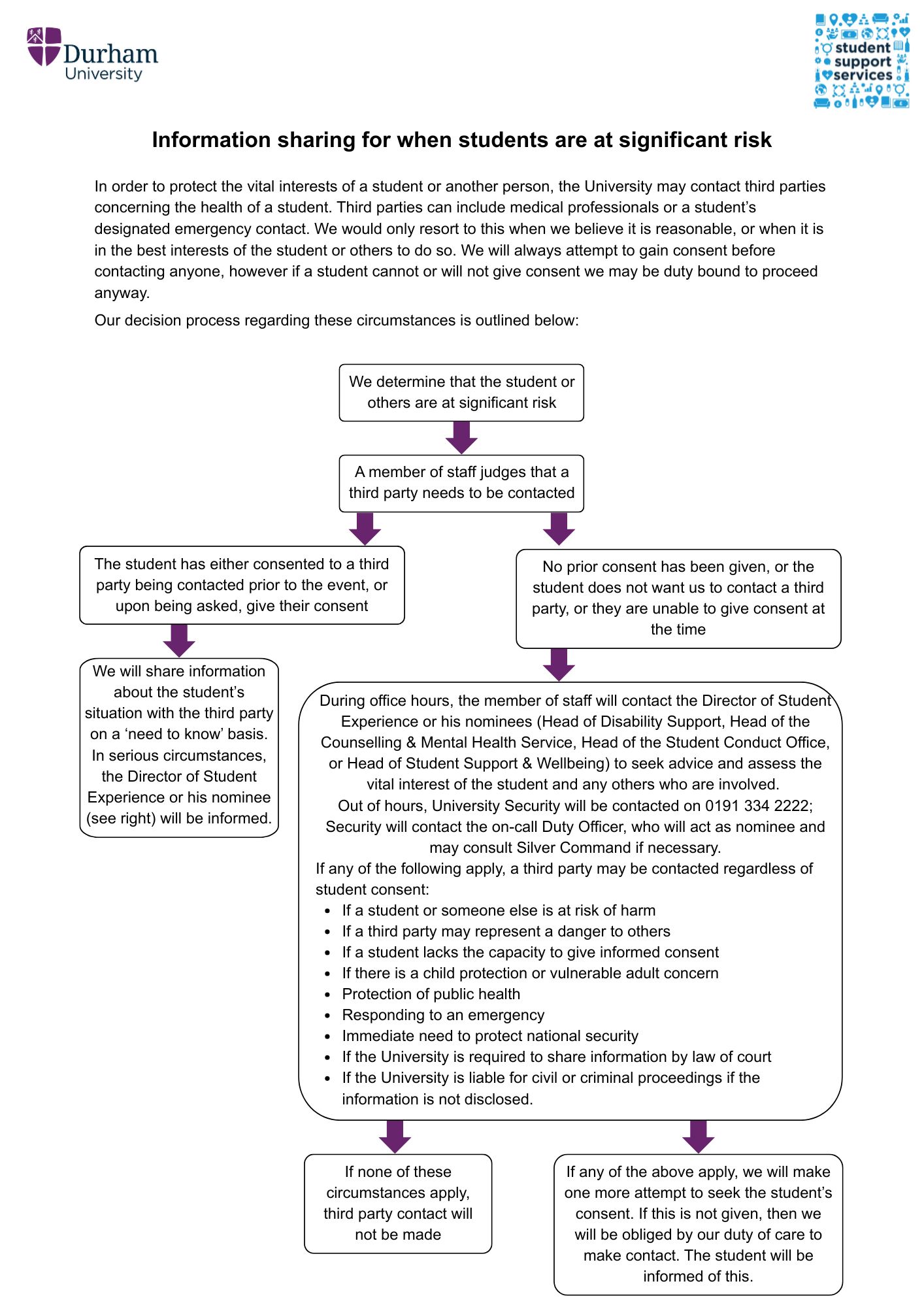
There are certain emergency and exceptional circumstances where the University may need to share information internally, with external agencies or with Emergency Contacts, whether consent has been given or not. The University may, to protect the vital interests of the student or another person, contact third parties, such as medical professionals or an Emergency Contact, concerning the health of a student when it believes it is reasonable and/or in the best interests of the student to do so. The University will attempt to gain the prior consent from the student to do so but where a student does not have capacity to consent or refuses to give consent, it might be necessary to act without consent. Whenever information is to be shared without consent the student concerned would be informed unless to do so would endanger their or another person’s vital interests.
Where information given in confidence concerns potential harm to an individual or to others, the University will weigh the duty of confidentiality against that potential harm. A decision to share information to a third party will be taken in consultation with the Director of Student Experience or his nominees (currently the Head of the Counselling & Mental Health Service, the Head of Disability Support, the Head of the Student Conduct Office, or the Head of Student Support & Wellbeing).
The circumstances when information provided by a student needs to be shared whether consent has been given or not could include but are not limited to the following:
-
Where it is believed that someone is at risk of harm including:
-
Where a student may be a danger to themselves or others
-
Where a third party may represent a danger to others
-
Where a student lacks the capacity to give informed consent
-
Where there is a child protection or vulnerable adult concern
-
Protection of public health
-
Responding to an emergency
-
Immediate need to protect national security
-
-
Where the University would be liable to civil or criminal proceedings if the information was not disclosed
-
When required by a court of law to provide information.
Where a decision to share information with a third party must be taken out of hours, the on-call Duty Officer (e.g., Assistant Principal/Vice-Principal/Principal) will act as the Director of Student Experience's nominee. In rare cases, if there is any doubt about the need to get in touch with an Emergency Contact out of hours, the Duty Officer may consult Silver Command via the Major Incident Response Plan (MIRP). Colleagues are required to record their decision and the rationale for it as part of the standard incident protocol.
Disability Support
A student may disclose their disability to any University employee who is then deemed to have received the information on behalf of the University. The staff member receiving the disclosure should explain to the student that they will share this information with Disability Support and the departmental Student Support Officer to ensure that the student can be contacted and provided with all available support options.
Disability Support will liaise with the student regarding supporting evidence required if reasonable adjustments are to be made (if the student is not already known to them). Relevant departmental support can be discussed with both Disability Support and the departmental Student Support Officer, to ensure a cohesive plan of support that best meets the needs of the student can be put in place.
Should a student decide, after liaising with Disability Support and/or the Student Support Officer, that they do not wish to engage further with support, that should be recorded on the Student Support Information Management System (SSIMS); the student remains able to return for support at a later date should they wish to do so. If there is a concern for a student's safety because they decide to disengage from support, this should be escalated to the Director of Student Support & Wellbeing (or their deputy) for further discussion.
A student at all times retains the right to choose not to disclose to the University any disability they may have. However, they will be informed that if they choose not to disclose a disability, this may impact the range of support that can be made available if relevant services are unaware of any specific requirements.
Counselling & Mental Health Service
Psychological Wellbeing Advisors (PWAs) and counsellors do not share the content of sessions with anyone outside the Service without consent. Only a student’s status as a user of the Service, and the number of sessions attended, are visible to student support teams within the University, for the purposes of student support.
Members of University gun clubs
Central University Support Services cross-reference all University gun club members to ensure that we are aware of possible risks if a student feels self-destructive or has thoughts of harming others. The University, on the advice of the Police may pause membership of DU gun clubs where students report information to support staff indicating the risk of endangering themselves or others.
Published September 2024*
*Updated October 2025 to amend 'Director of Student Support & Wellbeing' to 'Director of Student Experience' and to add the Head of Student Support & Wellbeing to the list of nominees.
* Updated July 2026 to clarify out-of-hours provision.
Please see diagram below for the University process for sharing information with third parties when a student is at significant risk.